Texas logs more hail events per year than any other state. East Texas adds high humidity and heavy storm seasons on top of that — a combination that puts more stress on roofs than most national estimates account for.
Every year after hail season, homeowners across Crockett, Huntsville, Conroe, and the surrounding region file insurance claims. And a lot of them don’t fully understand what roofing services actually cover, or how much that gap costs them.
This guide covers the full scope — from first inspection to final walkthrough, residential to commercial, local contractor to storm chaser, and what separates a 30-year East Texas operation from someone who drove in after the last weather event.
Key Takeaways
- Gun-nailed shingles aren’t a minor detail — it’s the difference between a roof that holds in a hail storm and one that doesn’t. Most homeowners never ask about it.
- Free roof inspections exist for a reason. Getting one before you file a claim — not after — changes the outcome.
- The insurance adjuster works for the insurance company. Your contractor should be in the room when they show up.
- East Texas humidity and storm frequency shorten roof lifespans faster than national estimates suggest. What lasts 30 years in Arizona won’t last 30 years here.
- Full-service means full-service. Not every contractor does gutters, metal, commercial, and specialty work. Verify before you hire.
What a Roofing Contractor Actually Does
People assume it’s shingles. The actual job is considerably bigger.
Inspection and Assessment
Everything starts here. A real inspection isn’t a walk-around from the ground — it’s the shingles, the underlayment beneath them, the flashing around every penetration, the fascia and soffit, the decking underneath everything, and the gutters if they’re part of the system.
Water damage at the eave line. Soft spots in the decking. Failed flashing at a valley. Granule loss on the south-facing slope. These are findings that determine repair vs. replacement — and the same findings an insurance adjuster may undervalue or skip entirely.
Lucas Roofing offers free roof inspections across all eight markets. No charge to come out and tell you exactly what’s there. That matters because most East Texas homeowners wait until something is actively leaking — and by then, a repair has usually become a replacement.
Material Selection
After the inspection comes the conversation about materials. In East Texas that usually comes down to three directions: composition shingles, metal roofing, or a specialty system.
Composition shingles — 20, 25, 30-year, and lifetime grades — are still the most common residential choice. Cost-effective, widely available, performs well when installed correctly. Metal roofing, in both exposed and concealed fastener systems in 24 and 26 gauge, lasts 40–70 years and handles hail and wind load better than shingles across the board. Specialty materials — slate, clay tile, concrete tile, wood shake — show up on older homes, churches, and architectural builds where the visual standard matters as much as performance.
A contractor who only works with one material type will push you toward it regardless of fit. That’s worth knowing before you hire.
Installation: Where the Difference Is Invisible
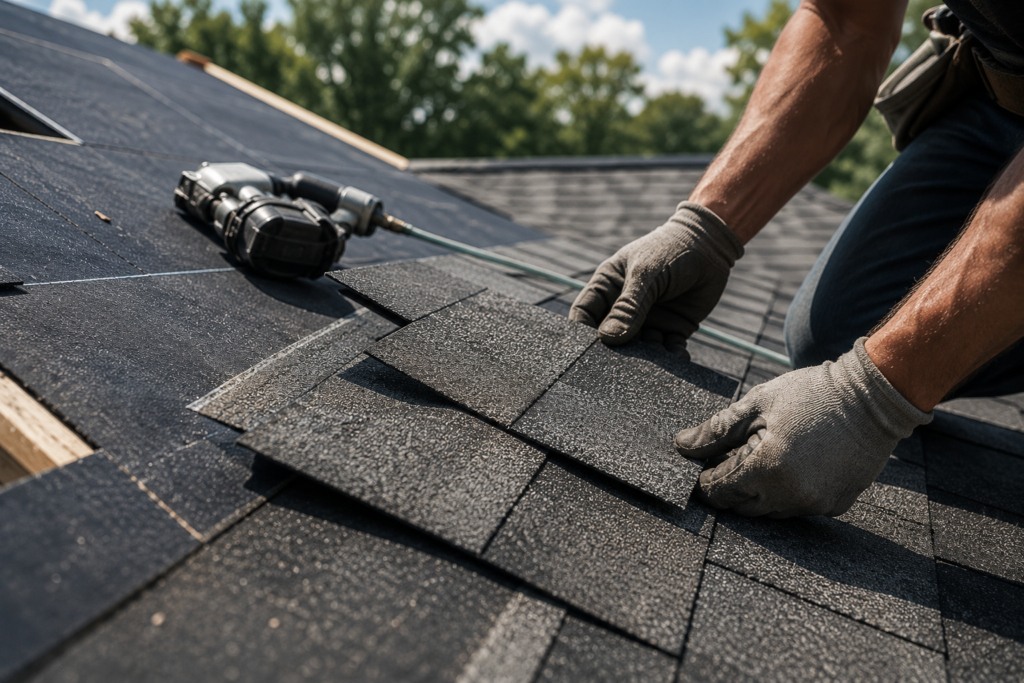
This is the visible part of the job. It’s also where quality differences are completely invisible from the street — and don’t show up until a storm arrives.
Lucas Roofing has done it this way for 30 years. Not a marketing line — it’s the production standard on every residential roofing job. In a region that sees East Texas weather, that difference shows up at claim time.
Beyond fastening: correct underlayment application, step flashing at every wall intersection, counter flashing at chimneys, drip edge at the eave and rake. None of it is glamorous. All of it is where roofs fail when it’s done wrong.
Gutters
A lot of contractors subcontract gutters or don’t offer them at all. Lucas Roofing fabricates seamless gutters in-house using an on-site machine — cut to exact lengths for your specific roofline, no seams that can separate over time. Sectional gutters have joints at every connection. Those joints are where failures start.
Seamless costs more upfront. Lasts longer. Requires fewer repairs. For East Texas homes dealing with heavy rainfall and tree debris, the longevity difference is real.
Cleanup
A roofing job produces a lot of waste — old shingles, nails, underlayment. A professional contractor removes all of it, including a magnetic roller pass for nails in the yard and driveway.
Final walkthrough covers the completed work, materials used, manufacturer warranty terms, and maintenance recommendations. Lucas Roofing’s standard: the job isn’t done until the customer is satisfied, not when the crew packs up.
Residential vs. Commercial vs. Specialty
Not every contractor handles all three. Here’s how the scope changes.
Residential
Single-family homes, duplexes, smaller multi-family. Shingles and metal are the dominant categories, though Lucas also handles tile, slate, wood shake, and flat systems on residential structures that call for them.
Standard shingle replacement on a single-family home typically runs one to two days. Extend that for steep pitches, multi-layer tearoffs, or roofs with significant penetrations.
Commercial
Commercial roofing is a different job. Flat and low-slope roofs — retail buildings, warehouses, churches, industrial — use membrane systems, not shingles.
TPO is heat-welded at the seams, strong UV resistance. EPDM is rubber membrane, excellent in temperature extremes. Modified Bitumen goes on in layers and produces a robust multi-ply system for high-traffic commercial roofs.
Lucas also installs Hydro-Stop Roof Restoration — a coating applied over existing roofing that restores the surface without a full tearoff. Worth evaluating before committing to a full commercial replacement if timeline or budget is a constraint.
Specialty
Church steeples. Slate systems. Clay and concrete tile. Wood shake on architectural homes. These require a contractor who’s actually done it — on atypical geometry, with uncommon materials.
Most local contractors in East Texas don’t offer specialty work. That’s not a knock — it’s a niche that takes experience most operations don’t have. Lucas Roofing has handled all of it across the region.
Working With Insurance: What Your Contractor Should Actually Do
In East Texas, a large percentage of roofing jobs start with an insurance claim after a hail or wind event. How your contractor handles that process matters as much as how they handle installation.
A qualified contractor inspects before you file, documents everything with photos and notes, and shows up for the adjuster inspection. That last part is where most homeowners leave money on the table. Adjusters work for the insurance company. A contractor who knows what granule displacement looks like, what shingle bruising looks like, what dented flashing looks like — they catch what adjusters routinely undervalue or call pre-existing.
Lucas Roofing crews have helped East Texas homeowners recover significantly more than initial adjuster estimates, specifically because the team knows where to look. If your contractor won’t be present at the adjuster inspection, ask why before you hire them.
Local Contractor vs. Storm Chaser: How to Tell the Difference
After every major hail event in East Texas, out-of-market contractors show up. Fast turnarounds. Aggressive pricing. Some do fine work. A lot of them are gone before a warranty claim matters — and in Texas, where hail seasons are reliable, that comes sooner than people expect.
Here’s what to check before you sign anything.
Permanent local address. A contractor operating year-round in Crockett, Huntsville, or Conroe has a physical location you can verify. A storm chaser works out of a temporary office or a rented suite for the season. Ask for the address and look it up.
How long they’ve been in the area. Simplest filter there is. A contractor with 30 years in East Texas has a community reputation they have to protect every year. A contractor who arrived last month doesn’t. Lucas Roofing has operated in the same community since 1995.
BBB record with actual history. A fresh LLC with no BBB file is not the same as a BBB A+ rating earned over 22 years of accreditation. Lucas Roofing has been BBB accredited since 2003. Verify it directly at bbb.org.
Reviews across multiple platforms — not just Google. A few Google reviews can be accumulated quickly. A contractor with 242+ verified reviews across Birdeye, the Chamber of Commerce, and Facebook — consistent 4.9 stars over years — can’t fake that.
Who backs the workmanship warranty. Material warranties are only useful if the contractor is still around to honor the workmanship side. Ask directly: “Where will you be in five years if I need to make a claim?” A contractor with 30 years in the region has a real answer.
What East Texas Specifically Does to Roofs
Composition shingles rated for 30 years nationally often run closer to 20–25 in East Texas. The combination of UV exposure, humidity cycling, and storm impacts accelerates granule loss and shingle degradation faster than drier climates.
The Insurance Institute for Business & Home Safety has documented that south-facing roof slopes can hit temperatures above 200°F in a single afternoon, and that rapid temperature swings — the kind East Texas gets regularly — accelerate granule loss and unsealing faster than any other weathering factor.
Metal holds up better here. The 40–70 year lifespan estimate is more reliable in East Texas than in lower-humidity regions — part of why demand for metal roofing across the region has grown consistently over the last decade.
Lucas Roofing serves Crockett, Conroe, Livingston, College Station, Galveston, Huntsville, Lufkin, and Palestine. Roof repair services and location-specific resources are available for each market. Commercial property owners can find system-specific information on the commercial roofing page.
What to Do When You Think You Need a Contractor
Start with an inspection. Cost is zero. Lucas Roofing offers free inspections across all eight markets — no obligation, just an honest assessment of what’s there.
After a storm, don’t wait for visible damage. Hail impact on shingles doesn’t always produce surface damage you can see from the ground. The granule loss and bruising that leads to premature failure often looks minor from the street. Getting an inspection within two to four weeks of a major event gives you a documented record — which matters if a claim comes later.
Commercial property owners: flat and low-slope roofs pool water differently than pitched roofs. Small seam failures cause significant interior damage before anyone notices. Annual inspections on buildings over ten years old are a reasonable standard.
Active leak? Call before scheduling. Lucas Roofing can move fast when it’s urgent — 1-800-839-9903 or (936) 544-7992 locally.
What Ignoring Roof Problems Actually Costs
Water gets into the decking. Decking rots. Rot spreads to the framing. Persistent moisture creates mold conditions. By the time a homeowner notices ceiling staining, the damage is usually several layers deep and three to five times more expensive to fix than the roof repair that would have stopped it.
The insurance side works the same way. A roof with documented maintenance history and professional inspections is less likely to have claims disputed. In East Texas, where hail claims are common, that documentation earns its keep.
Composition shingle replacement in Texas typically runs $8,000–$18,000 depending on size, pitch, material grade, and damage. Metal runs higher — $15,000–$35,000 for residential — but the per-year economics change considerably when the roof lasts twice as long. These are ranges. The accurate number for your roof comes from an actual inspection and written estimate.
Frequently Asked Questions
What’s the difference between a roofer and a roofing contractor? A roofer is a tradesperson who physically installs materials. A roofing contractor is the licensed business entity managing the whole project — inspection, materials, crew, permits, warranty. Sometimes they’re the same person. At Lucas Roofing, the owner is hands-on with every job.
How long does a roof replacement take in East Texas? Standard residential shingle replacement runs one to two days. Larger homes, steep pitches, or complex rooflines push that to three or four. Commercial projects depend on square footage and system.
Do I need to be home during the job? Not for the installation itself. But be present — or have someone there — for the initial inspection, the insurance adjuster walkthrough, and the final walkthrough. Those three moments are where your input actually changes the outcome.
What should I ask before hiring a roofing contractor? How long have they been in the area. Whether they’re BBB accredited. Whether they show up for adjuster inspections. How they fasten shingles — hand-nailed or gun-nailed. Whether gutters are fabricated in-house or subcontracted. What the workmanship warranty covers and for how long.
Does Lucas Roofing handle residential, commercial, and specialty work across East Texas? Yes — full spectrum. Residential shingle and metal, commercial TPO/EPDM/Modified Bitumen and Hydro-Stop restoration, specialty systems including church steeples and tile, and seamless gutter installation across all eight markets.
Talk to a Roofing Contractor at Lucas Roofing & Gutters
Free roof inspections, no obligation, across all eight East Texas markets. Call 1-800-839-9903 or request a free quote online. Serving Crockett, Conroe, Livingston, College Station, Galveston, Huntsville, Lufkin, Palestine, and surrounding East Texas.

